LTC-OS by LeanTheCompany · Lean for factory and office
Map it before you automate it.
Value streams, the processes behind every step, and the ways of working that support them — kept alive and true through Kaizen (continuous improvement), in one connected system.
Your plant needs this Lean layer before AI can help — and long after.
Gösta Seuranen
Founder · Sensei
25+ years on factory floors — from Tetra Pak, Danone, FrieslandCampina, Nestlé, Heineken, Stora Enso, Oatly, Nobia and Galderma. Now built into a platform, not a consulting retainer.
For Whom
Three moments when processes break faster than org charts can fix them.
Makigami works for any admin process. VSM works for any company producing goods. These tools are universal — but three trigger situations burn the loudest right now.
The AI Mandate
Leadership wants AI in every process by next quarter. But a model can only automate what's been mapped — point it at a chaotic process and you scale the chaos, not the output. Map the flow first, then automate the part that's actually ready.
The Demand Surge
Pharma, defense, medtech, energy — demand just doubled. Capacity didn't. Overtime masks the waste; mapping the flow shows where hours actually disappear so you add throughput, not headcount.
The Outgrown Process
You grew by patching. Ten years of workarounds, three ERP migrations, four re-orgs — and nobody can draw the current state end-to-end. Before the next change, make the chaos visible.
Lean consultants and coaches: run up to five client assignments at once, each client's projects and data kept strictly apart. Walk onto the shop floor with live process maps instead of a static PowerPoint — and when the work is done, leave your client a toolkit that keeps working.
Talk to us →The Problem
You don't have a people problem. You have an invisibility problem.
Every factory and every office runs on three kinds of waste that nobody writes down because nobody can see them. Until you draw them.
"Where there is no standard, there can be no kaizen." — Taiichi Ohno
And no agent.
01 · Chaos
Nobody knows the real process.
Ask five people to map the order-to-ship flow and you’ll get five different versions. The current-state map on the wall is three years old and two ERP migrations out of date. You’re making decisions based on a process that no longer exists — and nobody can explain why the complaint rate isn’t improving, or even agree on what “good enough” looks like.
02 · Handoffs
Handoffs eat more time than the work.
The machine cycle is 40 seconds. The order spends 11 days between people, inboxes and "waiting for clarification." Speed lives in the white space, not the value-added steps.
03 · Shadow
The knowledge isn't on the map.
A product grade change, a restart after a long shutdown, an unusual noise from the filling machine — whenever something unexpected happens, everyone turns to the same person.
That is where the way of working is most vulnerable: the critical knowledge sits in one person's experience, not in a documented process. It is also where an AI agent is most likely to fail, because the knowledge needed to make the right decision has never been captured.
Where LTC-OS sits
The layer nobody else holds.
AI agents
predict · recommend · act within limits
The Lean layer · LTC-OS
why it happens · what good looks like · which decisions matter · who knows
Context
what is happening, where
Data
sensors · MES · ERP · maintenance
- Data platforms know what is happening.
- LTC-OS holds why, what good looks like, and who decides.
- Agents work inside that. People still decide what becomes the way of working.
LTC-OS doesn't store sensor data, train models or touch your equipment. It proposes and records. People decide.
How It All Connects
Most tools start with the map. We start with the promise.
Define what you promised.
Choose your industry — the five things your customers judge you on are already there.
True NorthGrade yourself, 1 to 5.
Current against target, with defined criteria at every level. Evidence, not a show of hands.
5 valuescurrent → targetPut a number on every gap.
Which measure proves it, how large the loss is, how much you trust the data. Now you know where to look — before you draw anything.
Value–KPI BridgerankedMap where the loss lives.
The Value Stream Map gives the overview of the material flow, and each process step opens into its own detailed Makigami — showing who does what, where work waits, and how decisions are made.
Information & admin flowMakigamiMaterial flowValue Stream MappingFix it, prove it, write it down.
The Kaizen walk checks the result against the baseline and writes down the new way of working. The A3 is what the review reads.
PLANDOCHECKACTA3EN · SV · 中文
Every finished Kaizen leaves the new way of working written down. That's what your people train on — and what an agent will learn from.
Embedded Sensei
Not a step — it runs the length of the line. Ask where your biggest waste is at any point, and the answer comes from your takt, your handoffs, your losses. It proposes; your team decides.
Direction first. Then the map. Then the improvement. Never the other way round.
Live today
Ready for the day an agent joins the team.
One value stream and every process behind it.
Each VSM step opens into its own Makigami, so the office work, the hand-offs and the waits sit under the step they slow down.
Improvement doesn't stop at countermeasures.
The Kaizen walk checks the result against the baseline, writes down the new way of working, and names what would make the team look again.
AI that coaches. People decide.
Sensei asks from your own map and losses. What it suggests arrives as a proposal; only your team moves it on. That's the rule you'll want for every agent that follows.
Draw the agent in a swimlane of its own.
Give the AI its own lane on the future-state Makigami: which steps it does, where it hands over to a person, who checks it. The split between people and AI, drawn and agreed on the floor before anyone buys anything.
Next: the decisions and the know-how behind each step. We're building it with a few pilot plants and consultancies.
Map one line with me →What you get
What's live today.
Makigami, the Value Stream Map, the Kaizen walk, the embedded Sensei and the one-page A3 export are all live today. What you see below is the real platform — actual screenshots, not mockups.
The map that does the math.
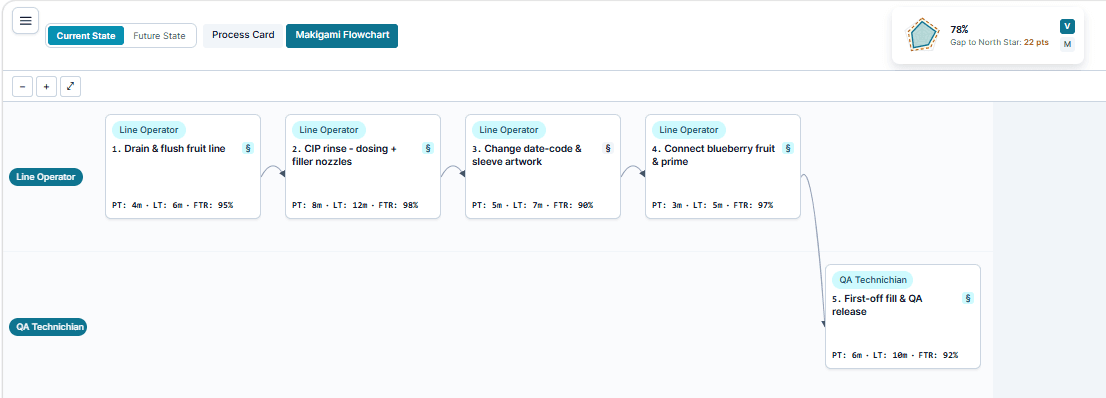
Makigami — the office flow
LiveThe back-office twin. Sales, engineering, purchasing — every handoff and every wait the shop floor never sees. Print it on the wall and the whole organisation suddenly speaks the same language.
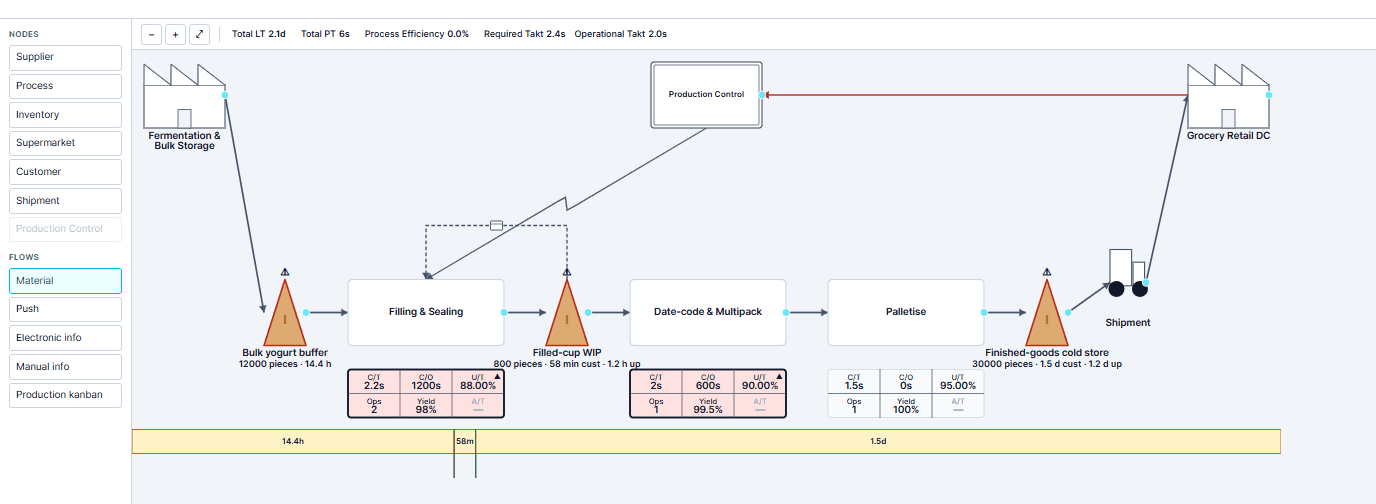
Value Stream Map — the material flow
LiveDrag process boxes, draw flow arrows, drop inventory triangles and kanban loops. Takt, lead time and inventory cover roll up automatically — build current state and future state, side by side.
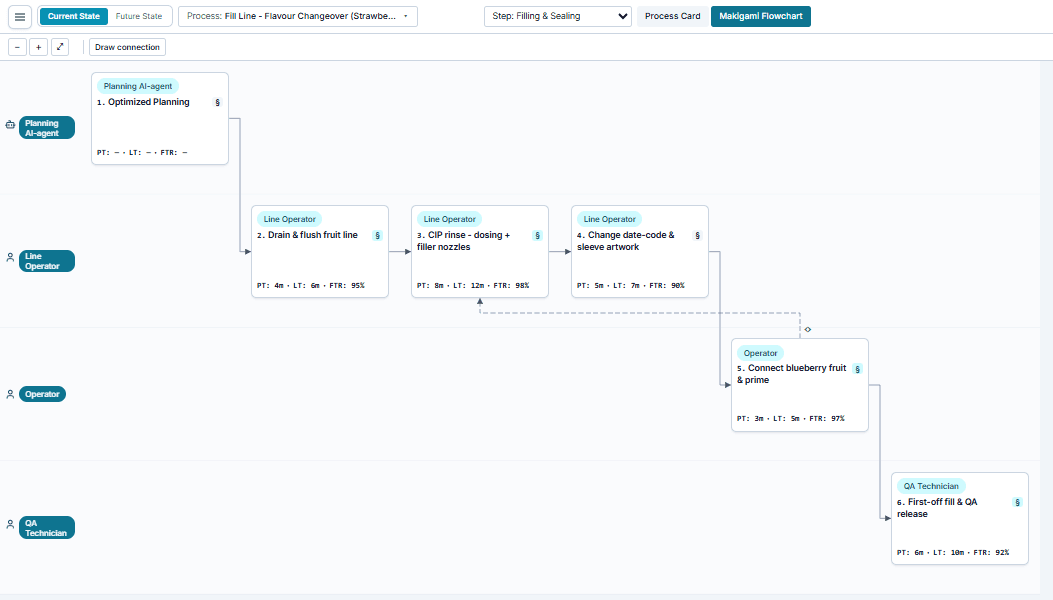
A Makigami behind every VSM step
LiveOpen any step into the process that feeds it.
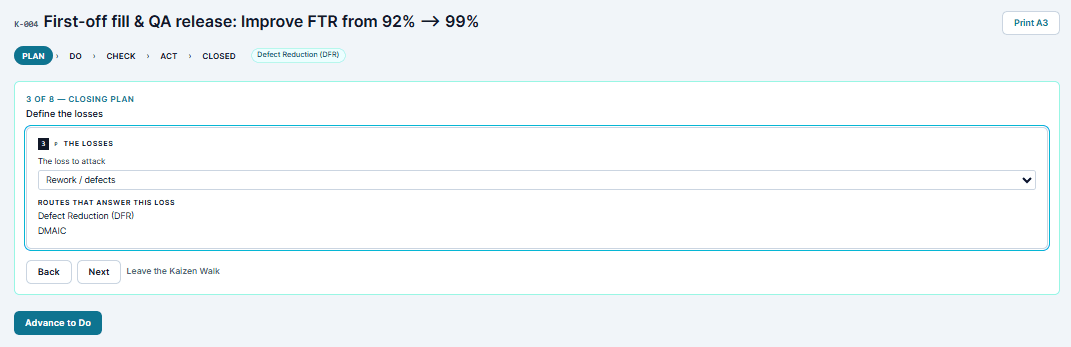
The Kaizen walk
LiveTwelve steps — from spotting a problem to setting the new way of working — covering 39 types of loss in four groups. Walk it on your phone, one step at a time, at the gemba.
Embedded AI Sensei
LiveAsk questions in plain English, Swedish or Mandarin. Its coaching is grounded in the work of Taiichi Ohno and Mike Rother and in 25 years of field experience — practical advice you can act on, without theory for its own sake and without preaching.
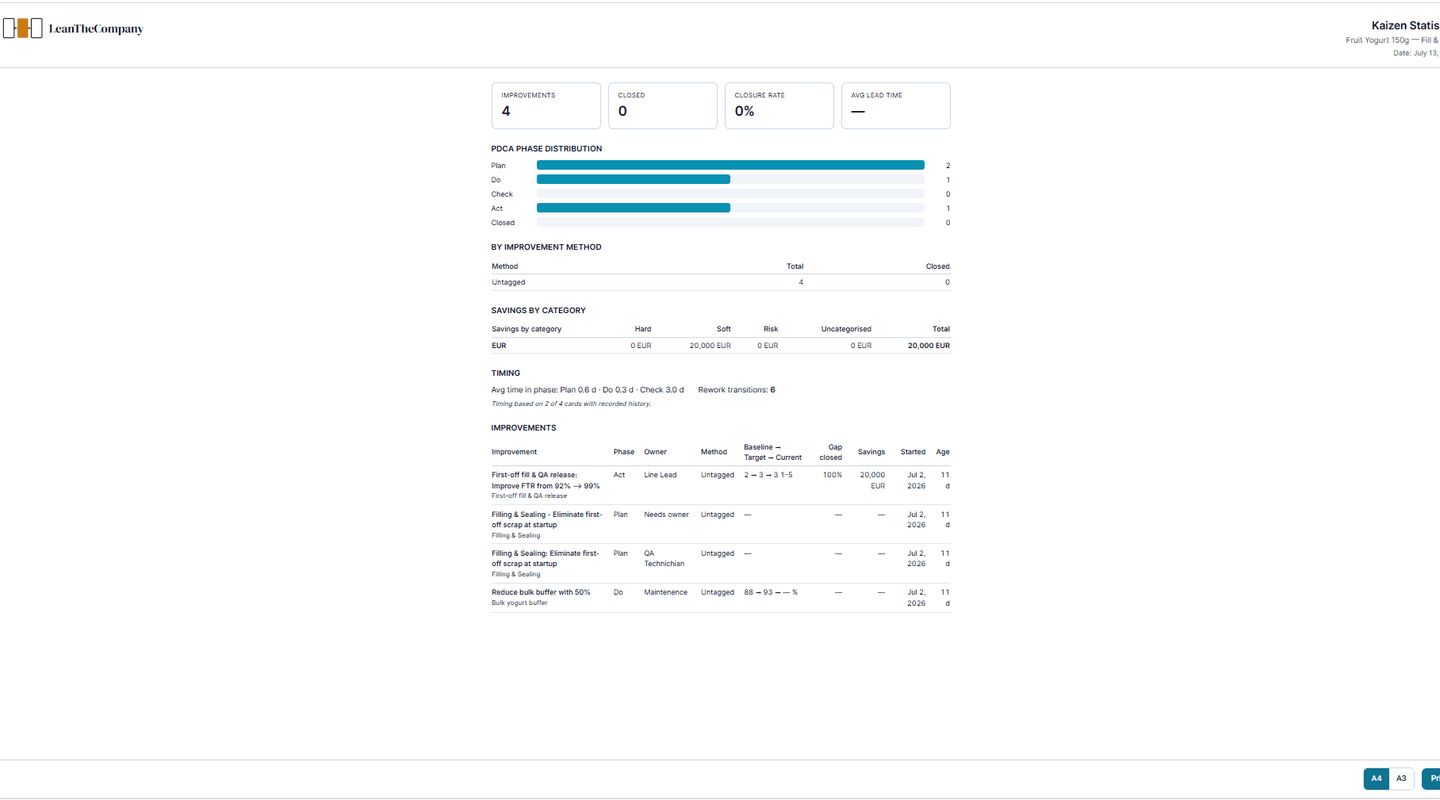
One-page A3 export
LiveThe universal language of Toyota Production System reviews worldwide. Print it. Pin it. Walk it. Every map, True North, and kaizen report exports as a branded A3 or A4 — in English, Swedish, or Chinese, today.
Process Owner
LiveOne plan for the team that owns a process end to end: eight seats, viewers free.
Free Diagnostic
Measure your process chaos in 5 questions.
Five questions about how work actually moves through your plant. The score lands on the screen when you finish — no email, no waiting. Each answer comes back with the note I'd give you standing on the line next to you.
What the Score Measures
- 01Inventory between steps
- 02Handoffs per order
- 03Shadow spreadsheets
- 04Decision cycle time
- 05Standardised work
What the Score Measures
- 01Inventory between steps
- 02Handoffs per order
- 03Shadow spreadsheets
- 04Decision cycle time
- 05Standardised work
Score your own plant.
Answer from the reality on the floor, not from what the report says. Your results stay private unless you choose to share them.
Your answers stay with the founder. No tracking. No reselling. No automated marketing sequences.
Test yourself
Ninety seconds on the floor. Six calls to make.
Not definitions. Real situations — a line missing takt, an improvement that doesn’t sustain, an andon nobody pulls. Choose the call you’d defend in front of the plant manager.
Pricing
Four ways to use it. One product, built once.
Contributor is a person. Consultant is a practice. Process Owner is a team. Architect is a partnership.
One Space, one process, seen properly.
An Operational Space is one business process — mapped as it actually runs today, and as it should run instead.
You map the office flow with a Makigami and the material flow with a value stream map. You mark where the time really goes. Then you draw the future state, and the kaizen cards are the work that gets you from one to the other.
One Space holds all of it, including the record of what you tried and what happened. Add another Space for the next process. That is the whole system.
A Space doesn't get abandoned. It graduates.
Your plan sets how many Spaces you can work in at once. It does not set how many you can keep.
When a process is good enough and stable enough to run without you, that Space is finished — so you archive it. It stays readable, printable, exportable, and it never counts against your active limit again. Bring it back whenever you want. Nothing is ever deleted.
Keep everything you finish. And if you stop subscribing, you keep read-only access to all of it for two years, with export available the whole time. We’ll remind you before anything goes.
You did the work. It’s yours.
You could do this on a whiteboard. People try.
Miro, Lucidchart, a PowerPoint template — €5 to €9 a month for shapes and arrows. They're good tools. They just don't know anything.
A generic digital whiteboard doesn't understand value stream mapping. It can't find a handoff loop in your Makigami, turn what you found into an A3 your steering group will act on, or keep the reasoning behind the process after the consultant has gone.
Eleven months later, when the workshop is a distant memory, the organisation still needs to know not only how the process was mapped, but why it was designed that way.
Many whiteboard tools add another limit: when the subscription ends, the boards go read-only, and you may have to delete content to get back in.
We do it differently. Finished improvement work is archived and kept, at no extra cost. If you end your subscription, you keep access to your work for two years, and you can export it at any time.
Your process knowledge should stay your company's asset — not depend on an active software subscription.
The difference isn't what the map shows. It's what the map knows — and who owns that knowledge.
Contributor
For the people who do the work
For the operator, analyst or engineer who wants to map their first process tonight — on their own laptop, with nobody asking permission. Start where the work actually happens.
- 5 active Operational Spaces — five processes improving at once
- Keep every Space you finish — archived Spaces stay free and never count against your five
- Export to A3 PDF (EN / SV / ZH)
- AI Sensei — 50 questions a month, top up any time
- Private workspace — just you
- Founder replies within two business days
- €19 / month
- An improvement cycle usually takes 12–15 weeks. With five Spaces running at once, a team can finish about 17–22 improvements a year. Finished Spaces are archived at no extra cost, which frees room for the next five.
30 days free on your first subscription, then €19/month. We’ll email you before the first charge.
Consultant
For the people who coach the work
For independent Lean consultants and coaches building their first client base. Each client's Spaces are kept separate from every other client's, so you can run workshops with live, interactive process maps instead of a static PowerPoint — for less per month than one hour of your consulting fee.
- Everything in Contributor
- 5 clients
- 25 active Operational Spaces, pooled — put 12 on a big plant and 5 on a small one, your call
- Keep every Space you finish, across every client
- AI Sensei — 150 questions a month, pooled, top up any time
- The Kaizen walk, with PDCA
- Founder replies within two business days
- €69 / month
- Consultant is five Contributor licences in one. Bought separately they’d be €95.
30 days free on your first subscription, then €69/month. We’ll email you before the first charge.
Process Owner
For the people who own the process
For the manager or team responsible for a process end to end — across departments, sites or shifts. Shared, interactive process maps make roles and responsibilities clear, and give one reliable source of truth instead of scattered screenshots and documents.
- Everything in Consultant
- 8 seats included — a seat is a person who edits; viewers don’t need one
- More editors any time: €31 a month per extra seat, added in the app
- No limit on Operational Spaces or clients (fair use)
- Owner, editor and viewer roles — invite by email
- AI Sensei — 300 questions a month for the team, top up any time
- Founder replies within two business days
- €249 / month
30 days free on your first subscription, then €249/month. We’ll email you before the first charge.
Architect
For the people who design the system
For the continuous-improvement lead, business architect or external partner running LeanTheCompany across many teams or clients.
Architect isn’t a subscription tier — it’s a partnership, and it’s priced as one. None of it is built yet. We build it with the first partner: revenue share on every paid seat you refer, multi-workspace across clients or business units, white-label export with no LeanTheCompany mark, and workspace handoff to a Contributor seat.
If you’re running Lean inside a consultancy, an OEM academy or a university programme, tell me now and you’ll be first in the queue.
Prices excl. VAT
Sensei top-ups are €12 per 100 questions, and credits never expire. Extra seats on Process Owner are €31 a month each.
Sensei runs on real AI, so we measure its use openly — and you can top up whenever you need. Map storage has no limit: create and keep as many maps as you need. The price stays predictable, with no surprise charges.
Founder replies within two business days — Monday to Friday, excluding Swedish public holidays and the July period.
Pilot
Map one line with me.
I'm building the next layer — the decisions and the know-how behind each step — with two or three plants or consultancies. Ninety days, one value stream, one hotspot.
Weeks 1–2
Map the flow.
The value stream of one line, the Makigami of its hotspot. Name who owns the process.
Weeks 3–4
Find the decisions.
What is decided, by whom, how often, at what cost.
Weeks 5–8
Capture while improving.
A Kaizen walk with the expert, a successor and your consultant. It ends with the new way of working written down.
Weeks 9–12
Hand it to the agent.
Your data team reads the result. The agent's first suggestion goes through PDCA like any other.
One way of working written in the expert's own words. One successor who can explain the decision. One agent suggestion that went through PDCA, adopted or rejected with a reason.
Gösta Seuranen
Founder · Sensei
Engineer, operator, coach. 25+ years across Europe and Asia — from the shop floor to the boardroom — before I wrote a single line of code.
Connect on LinkedIn →About the Founder
Three industries. The same problem keeps surfacing. That’s why LeanTheCompany exists.
My career in operations management began at Tetra Pak. Ten years of hands-on experience on the production line gave me a solid foundation in manufacturing, operations and continuous improvement, and shaped the working methods I still use today: seeing the actual workflow, understanding the real problems that arise on site and the gap between process design and actual operation.
Companies change. Products change. Operating environments change. Yet the underlying process problems are often remarkably similar. Years of practice reinforced a simple principle: consultants can help solve individual problems, but sustainable improvement depends on an organization’s ability to see how work actually flows, identify the gaps between current and target performance, and improve the system continuously.
That is why I founded LeanTheCompany — a management system built on more than 25 years of hands-on operational experience, tested and refined across many industries and operating environments.
It gives teams a structured way to make processes visible, set improvement priorities and build the internal capability to keep improving — so improvement becomes part of daily work instead of depending on external consultants.
I spent 25 years making processes visible so people could improve them. Now the same maps have a second reader.
MSc Electrical Engineering
Lund University of Technology (LTH). Systems, control, and measurement — the engineering foundation behind every good Lean diagnosis.
MBA
Uppsala University. Added a commercial and leadership perspective to the engineering foundation.
Next step
Stop Reacting. Start Improving.
Start your pilot
Pick one value stream. Map it this week. Deliver your first visible improvement before the end of the month.
No login wall. No sales call. No obligation.